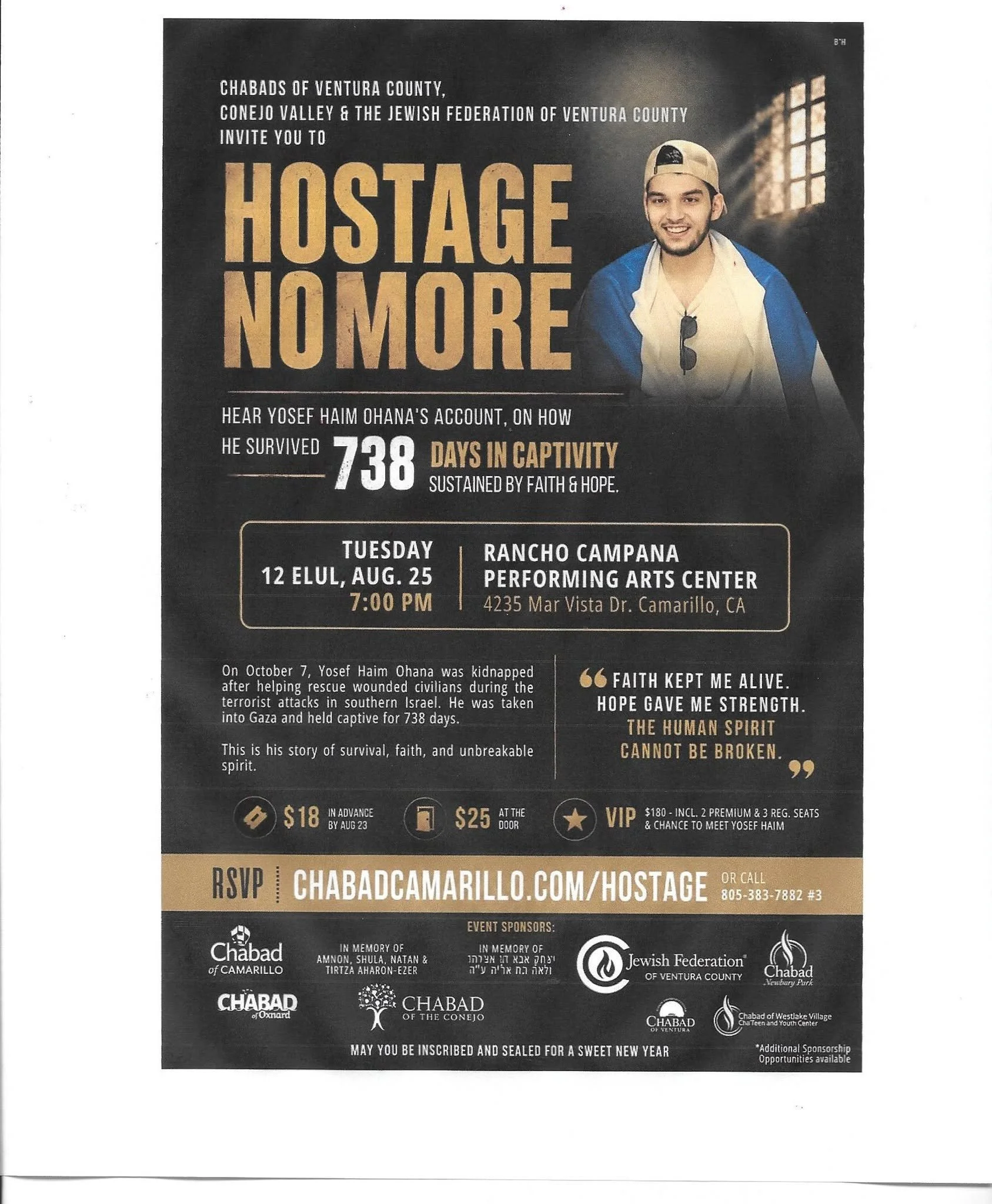
First, thank you to Camarillo Spotlight for posting about the event below. I did attend. I just felt like I needed to hear this man’s own words. I wondered whether, through hearing about his suffering and survival, there might be something I could learn about what is happening within our own community—and about how I can be a better human being.
Notes on survival, meaning, freedom, and compassion
One of the strongest ideas I took from Yosef’s talk was that survival was not only about what happened to his body. It was also about protecting some part of his mind and inner life from being controlled by his captors.
Uncertainty could leave room for hope
He talked about uncertainty as part of how he survived. Not knowing exactly what would happen next could leave room for hope rather than being trapped in the expectation that something terrible was definitely going to happen.
Finding joy in an unimaginable moment
He described having his feet tied to a stick while he was beaten. Before the beating began, he thought his captors had taken him away to kill him. When he realized they were beating him instead, he said that despite the pain, he felt relief because he knew he was going to live.
He said he smiled inside but did not let his captors see him smile. He was still being hurt, and it still hurt, but in that moment, being beaten meant he was alive. That part of his story stayed with me.
Love, peace, and compassion
He spoke about three values: love, peace, and compassion. What struck me was that even under the conditions he endured, these were still part of how he thought about himself and the world.
Having something to care about
Another important idea I took from his talk was the importance of caring—caring deeply about something, caring about someone, or knowing that someone cares about you. That connection can give a person a reason to keep going.
The battle for the mind can continue after physical freedom
Perhaps one of the most powerful things he discussed was brainwashing and the lasting effects of captivity. It made me think about how physical freedom and mental freedom may not happen at the same time. Someone can leave captivity while still carrying what happened to them.
What connected these ideas for me
Physical freedom and mental freedom are not necessarily the same thing. What I heard in Yosef’s story was the importance of holding onto meaning, relationships, values and some sense of yourself even when another person has control over almost everything else.
A question his talk raised for me
His emphasis on love and compassion made me think about forgiveness and healing. Does healing need to come before forgiveness, or can forgiveness itself become part of the healing process? And how do we forgive one another after periods of deep division?
I think about that in our own country and what happens after this after this period of division. How will people who have spent years angry with one another begin to embrace each other again? How do we rebuild relationships after so much division and distrust? That concerns me.
I also don't think healing can be reserved only for the people we agree with. People who have been swept into anger and hate will need healing too. If we want to come back together, at some point we have to figure out what forgiveness looks like—not as an excuse for what has happened, but as part of finding our way back to one another.